So Many Questions: Technology, Identity, Space, and Time (MSTU 4020; Week 6)

Not to come across cheesy or hyperbolic, but I must say that I have been enthralled by the topics we've been discussing so far in class. I think it's mostly because I've always wondered about these topics ever since undergrad when I wrote my first paper on the linguistics practices in online chat rooms (circa 2000). Being surrounded with folks who not only share my interests in these topics but offer new ways of understanding and questioning what technology is and what our relationship is to technology has been an intellectual mind blow for me. Because of my experience in class so far, I think I'm well on my way to better articulating ideas that float abstractly in my brain. I've been exposed to other kinds of languaging and theorizing that I believe will help me make better sense of the abstract thoughts about technologies' relationship to identity, space, and time.
Looking back at previous blog posts and notes, I notice the following questions emerge:
- How do the way we use digital technology define us as a society and as individuals?
- Who or what owns the virtual space where we convene socially and intellectually?
- How are we producing knowledge via the Internet and digital connectivity?
- Who are we in 'real' space? Who are we in virtual space?
- How do our digital worlds see us?
- Why do we think there is a separation between who we are offline/digitally disconnected and who we are online/digitally connected?
I recently published an article on The Loop 21, "Who Are You in the Digital Age?" which asks similar questions about technology and identity.
The following themes continue to pop up in my head:
- Space
- Time
- Geography, topography of non-physical space
- Identity/place
I'm still mulling over the connections between digital connectivity, space, time, identity, even space-time, if there is such a connection. My brain was working overtime when I created the following flow chart/image collage (see below). I had to draw out my notes and questions to see where the connections might be.
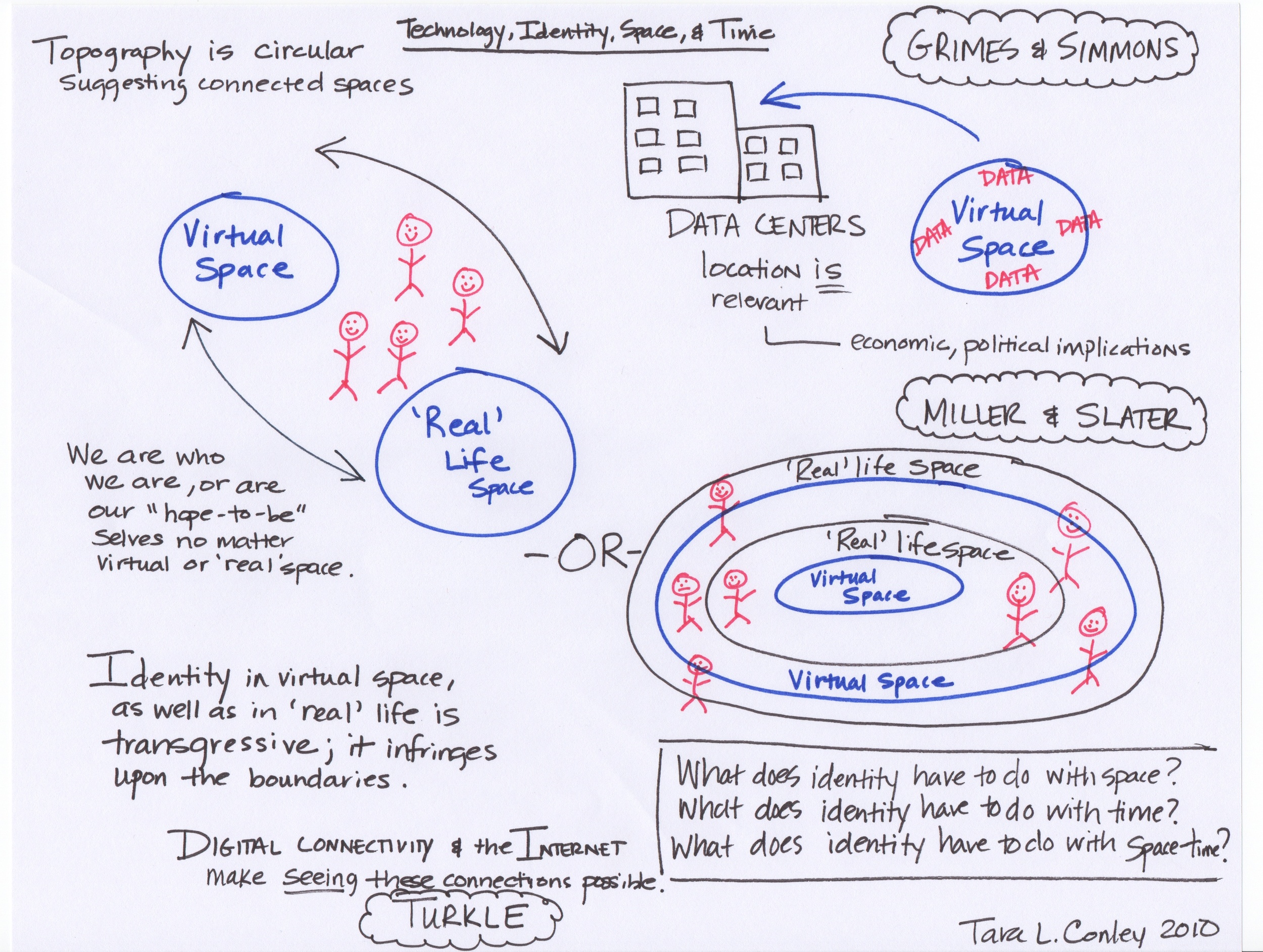
Click to enlarge
In this diagram you'll notice some of the questions illustrated above, along with new questions such as:
- What is 'real'? What is virtual? Are these ideas separate or connected?
- What constitutes the boundaries between 'real' and virtual?
- Is virtual space constructed by data? Do we build it? Or do our identities build virtual space (I'm thinking of Miller and Slater's article specifically)?
I don't believe that we are dis-embeded or disembodied according to the geographical or spatial location. Though I learned from this week's readings that data (unlike the concept of identities in virtual space) can be located, collected, managed, and stored. It's not simply a random entity that's "out there somewhere" (see Grimes & Simmons article). BUT, looking at the chart I created above, there may be a spatial connection between our identities and data...Hmm.
With all of that said, one thing seems certain; that digital connectivity and the Internet makes seeing these connections possible (see Turkle article).
My thoughts and ideas about these topics are still very much a work in progress. I'm interested in hearing your thoughts about the connections between technology, identity, space, and time.
FYI - I'm currently reading Janna Levin's book How the Universe Got Its Spots: Diary of a Finite Time in a Finite Space. Dr. Levin is an astrophysicist and professor at Columbia University. So if you're wondering why my thoughts seem a bit spacey, that's why.
References:
Turkle, S. (1995). Life on the screen. New York: Touchstone. (Introduction: Identity in the Age of the Internet and Ch. 7: Aspects of the self. -
Miller, D., & Slater, D. (2000). Being Trini and representing Trinidad. In D. Miller & D. Slater (Eds.), The Internet: An ethnographic approach (85-115). Oxford: Berg. -
Jaeger, P. T., Grimes, J. M., & Simmons, S. N (2009, May). Where is the cloud? Geography, economics, environment, and jurisdiction in cloud computing. First Monday, 14,(5 – 4). URL: http://www.uic.edu/htbin/cgiwrap/bin/ojs/index.php/fm/rt/printerFriendly/2456/2171
A Short by Tara
The following is short film I created for a graduate course in Video As Art. Here I play with direction, movement, time, space, area, and size by juxtaposing architectural design to people, all of which surround the iconic Apple symbol located on 5th Ave in New York City. Music by De La Soul "I Am I Be". YouTube disabled the sound when I uploaded because I used a De La Soul track. YouTube sucks for that, however, the silent version is still an interesting video.
Now take a look at the video with sound. By the way, Vimeo is awesome because they allowed me to keep the soundtrack.
A Short from Media Make Change on Vimeo.
Interpretations welcome. All photography and video by Tara L. Conley.
Identity, Representation, and Death in Virtual Space (MSTU 4020; Week 5)
The following post is a weekly response for a graduate course on Social & Communicative Aspects of the Internet at Columbia University, Teachers College. I invite all Media Speaks readers to engage by adding comments below.

I enjoyed engaging with this week's readings because issues of identity and representation in virtual space suit my research interests at this point. I was particularly drawn to Sherry Turkle's chapters "Introduction: Identity in the Age of the Internet" and "Aspects of the Self." Though published in 1995, Turkle's ideas about self representation through virtual spaces are still relevant today. I wasn't too familiar with MUDs (Multi-User Domains) before reading Turkle, though I immediately associated MUDs with Twitter and Facebook, particularly concerning how people use these spaces to interact and create community. Below are a few ideas from each chapter that are worth noting as we think about identity and representation.
From "Identity in the Age of the Internet"
- "The culture of simulation affects our ideas about mind, body, self, and machine" (10).
- The self is constructed (10).
- "On MUDs, [and I'd also argue on popular social networks of today], one's body is represented by one's own textual description" (12).
- Computers have identities (18).
- "Are we living life on screen or living in the screen?" (21).
From "Aspects of the Self"
- As we enter virtual communities we reconstruct our identities (177).
- The Internet is another means of explaining or perceiving identity as multiplicity (178).
- "More people experience identity as a set of roles that can be mixed and matched, whose diverse demands need to be negotiated" (180).
- "Do our real life selves learn lessons from our virtual personae?" (180).
Turkle also discusses mental health in the context of virtual life; do MUDs, or social networks, exacerbate difficulties or contribute to personal growth? I'd argue that we cannot necessarily approach this issue as an "either/or" problem. Virtual life and social networking can magnify mental and emotional afflictions but perhaps participating in these worlds can also provide a way to work through issues since, for the most part, we are still connected to a community of people, some of whom may function as a support system.
I'm not sure I can point to one particular idea that I adamantly disagree with, though perhaps I can expound upon one particular idea Turkle mentioned in the Introduction.
She writes that "one's body is represented by one's own textual description" (12). I wasn't sure if Turkle was referring to textual description as only written text or including other modes. The body surely can be represented (or manipulated as Turkle's seems to be implying when referring to textual description) through other modes like visual description, as in still and moving images.
Take for instance post-mordem photography presented in virtual space. How is the self represented through death? How is the body represented through the dead's visual description?
I thought about an art exhibit that a photographer told me about while we were discussing (on Twitter) the implications of taking still pictures of the dead. The discussion revolved around representation, privilege, and what death or dead bodies mean as we view them in photography. Needless to say I was struck by the images below (see link). I also thought about the cultural/social meanings associated with the idea that a white photographer (Elizabeth Heyert: http://www.elizabethheyert.com/) snapped photos of dead black bodies. I believe the family of the dead allowed the photographer to take these pictures. Still, there's something unsettling about the presentation of images, especially as these images are digitized and widely accessible via the Internet. I can't help but wonder about the photographers relationship to the images and her "use" of them through exhibition, and too, our perception as the virtual viewer of the body as it represents death.
http://www.mediamatic.net/page/65222/en (Warning: These images may be unsettling).
I think issues of identity and representation of human life, and even death, are truly fascinating because the Internet itself is, as Turkle argues, a means through which we can see identity--as well as community and language--as multiplicity.
Are Net Geners Really Tech Savvy Learners? (MSTU 4020; Week 4)
The following post is a weekly response for a graduate course on Social & Communicative Aspects of the Internet at Columbia University, Teachers College. I invite all Media Speaks readers to engage by adding comments below.

I was delighted to read Kirschner and Karpinski's article "Facebook and Academic Performance" because I'm sure this article will continue to spark plenty debates between educators and professionals, as indicated in the First Monday journals. I had first heard about the statistic that "Facebook users have lower GPAs and spend fewer hours per week studying than non-users" via Twitter. Kirschner and Karpinski's findings were significant enough to be published on TIME, although the media hype surrounding the article is a major academic criticism of the study overall. However, it's also important to mention that there is plenty of room for improvement in this study. The researchers indicate limitations and ways to better improve qualitative data at the end of the article.
Another reason I was highly engaged with this article is because it's relevant to other ideas I've been thinking about lately concerning our new generation of tech users and learners. I often wonder if students and minorities are, in fact, learning via online spaces. How do we understand literacy via online spaces in urban communities as African-Americans mobile users are on the rise, for instance? I posed a similar question about the relationship between literacy, new technology, and urban communities on Twitter a few weeks ago. I cited digital scholar, Allison Clark, who stated (paraphrasing) that we can't research or print a paper using a mobile device. I also wrote an article addressing a similar topic on The Loop 21.
Needless to say, the initial responses I received from Twitter and from my article were from people who immediate came to the defense of mobile technology. Some stated that because mobile technology is so innovative and rapidly expanding that we can, in fact, learn and become more literate through this type of media. Though I'm reminded of the conversation we had last week about the difference between information and knowledge.
Are what we're doing (or learning) by way of Google, Wikipedia, and on mobile devices ("passive consumption of information") a true indicator of knowledge production?
Kirschner and Karpinski's article also asks us to consider whether or not Homo Zappiens or Net Geners (those multi-tasking "techies" born in the 1980s and 1990's) have a deep knowledge of technology, especially when learning-by-doing "is often limited to basic office suite skills, e-mail- ing, text messaging, FB, and surfing the Internet" (1238).
So I wonder, are net geners really tech savvy learners or simply consumers of "low level", passive, or superficial technology? How might we measure knowledge production when the majority of minority net geners are using mobile devices to access the Internet?
And now, your moment of Zin.
Who Owns Cyberspace? (MSTU 4020; Week 3)

This week's reading discussed the implications of cyberspace on (and as) society and economy. I was particularly drawn to Dyson's et al. piece "Cyberspace and the American Dream: A Magna Carta for the Knowledge Age" and Webster's "The Information Society Revisited." Admittedly, I found myself distracted by the date on which these pieces were published, especially the Magna Carta piece (1994). How might these articles best relate to technological advances since 2009? We've discussed before the rapid changes in technology and how these changes almost certainly influence our social, cultural, economic, and political lives.
For the most part, the Magna Carta article came across as a melodramatic argument for technological determinism of cyberspace. Released in 1994, this "living document" constitutes a guide, (akin to The Constitution perhaps?), which encourages future readers to learn from and add to ideas about the impact of cyberspace on society. I'm not sure if or when this document was last updated, although I hope, for the sake of its purpose, that this document is still a work in progress.
However, one of the most notable quotes from the Magna Carta article came from a 1964 quote by libertarian Ayn Rand. It reads:
Government does not own cyberspace, the people do.
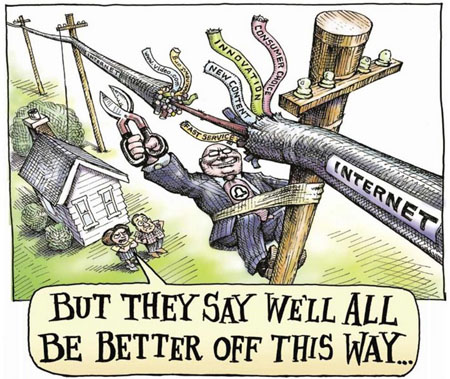
This quote immediately made me think about net neutrality. Sure, the government does not own cyberspace, but neither does, or should, corporations like Google and Verizon.
Net Neutrality Explained
It's interesting that Dyson's et al. piece talked about the idea of property rights in cyberspace since it appears like the founding mothers/fathers of this document didn't account for The Great Recession of 2010. Neither, perhaps, did they consider that the election of the first African-American president of the United States would ignite a fire storm within U.S. politics. Could they have ever imagined that conservative and libertarian media personalities like Glenn Beck would publicly condemn the president and his Administration as socialist for expanding broadband Internet access to poor and rural communities? Did the authors of this piece ever wonder about how the progressive left and far right would fight to the death about government regulation of the Internet? From a 1994 perspective, I can only imagine how easily it was to romanticize an open, neatly regulated, and "demassifyied" virtual landscape. Though in present-day reality, it seems as though cyberspace has turned into an even more contentious landscape.
The Young Turks Vs. Glenn Beck on Net Neutrality
If anything, the views expressed in the Magna Carta article could be best categorized as technological determinism. Tech advancements of cyberspace as a determining factor to the progress of our society as a whole does not necessarily signify a happy ending of a utopic society, but perhaps best functions as a starting point to a very long, exhausting, and controversial debate.